Imagine your agent has to get five things done today.
Send a parcel, book a mobile plan, get a car insurance quote, order a running shoe, request chemicals for the company. Five errands, five DAX brands, one day. The day is invented, the five results are really measured S1.
The same agent, five websites, three different outcomes. At DHL the parcel price is there, machine-readable; at adidas an error page appears before the agent sees a shoe S9 S7. The agent has to give up. The customer who sent it gets the shoe somewhere else, or not at all. Whether an agent completes its errand is not decided by the agent alone. The website it lands on decides too.
That is exactly what we measured at all 36 companies. How, is in the next chapter. What came out of it, in the four after that.
The same agent, five websites, three different outcomes. The website, too, decides whether the agent completes its errand.
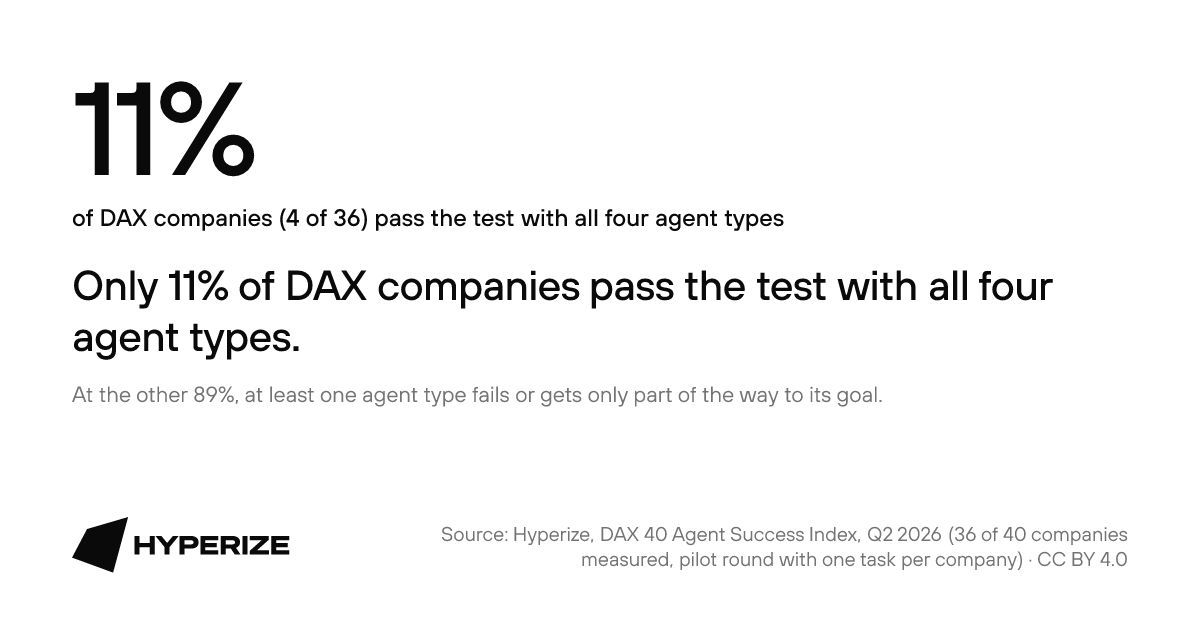
Only 11% of DAX companies pass the test with all four agent types.
Four technical ways of accessing a website, one real customer task per company. Passing means: every agent type reaches the goal set for it (from a readable price to the cart). No purchase.
At the other 89%, at least one agent type fails or gets only part of the way to its goal.
How we measured.
A purchase is not a single click but a series of steps. The agent has to find the brand, get onto the website, read the offer, choose the right variant and get through to the cart or the quote. It can fail at any step.
The DAX 40 Agent Success Index measures exactly where S1. Each brand gets one task, set and published before the measurement so that nobody picks the easiest one afterwards S3. Then four technical ways of accessing a website attempt the task; we call them agent types. The four differ a lot, and that decides a great deal later on:
Loads only the text of the page, without images, without clicks, without programs in the background. What is not written here does not exist for it.
This is how AI search engines read most pages today when they cite a source.
A program that calls up pages, pulls out data and fills in forms. It can calculate, but it cannot see what happens on the screen.
This is how price comparison sites, shopping bots and many home-built company tools work.
Controls a real browser: clicks, scrolls, reads the page the way a human sees it. Slow, but closest to a human.
This is how the agents in ChatGPT, Claude and Gemini work when they get something done for you.
Plans by itself, tries out routes, switches to another one when blocked, calls other tools. Needs no step-by-step instructions.
This is what the buying agents now emerging look like.
So there is no such thing as the one AI agent. There are four types with four different sets of abilities, and they are developing fast. A website that lets the browser agent through may lock out the plain fetch, the one AI search engines use today to read and cite pages. These four types appear as columns in every chart in this article, in exactly this order.
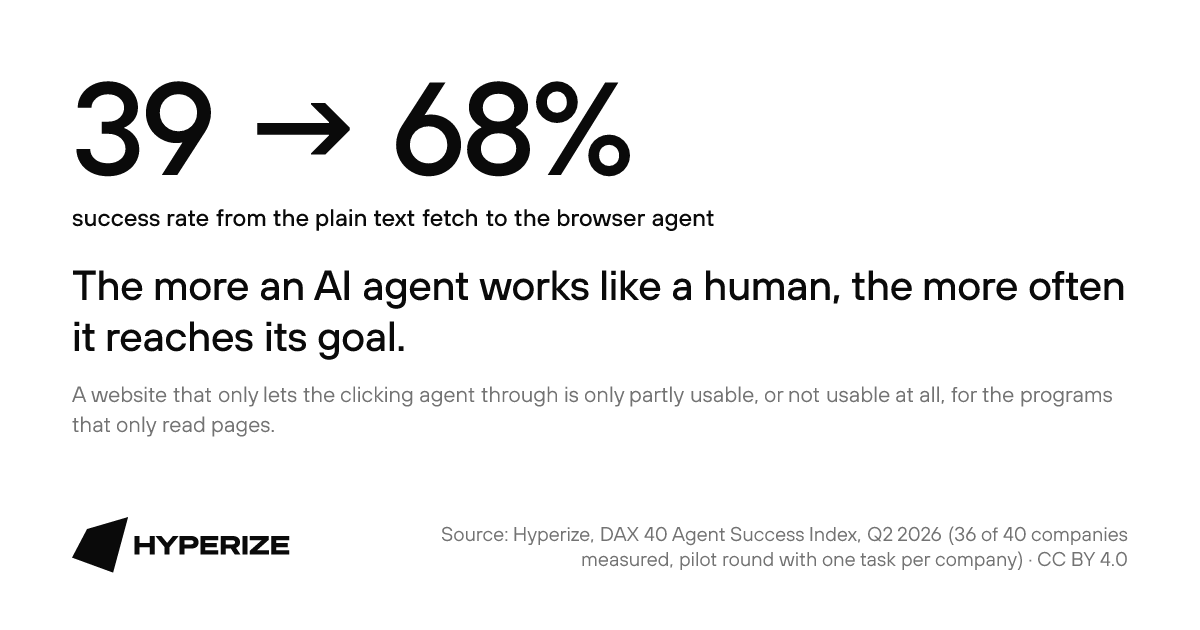
The more an AI agent works like a human, the more often it reaches its goal.
Share of tested websites on which the agent type reached its goal. The agent types ran on different numbers of websites (36, 36, 22, 18); no direct comparison on the same websites.
A website that only lets the clicking agent through is only partly usable, or not usable at all, for the programs that only read pages.
Two values per brand. First, visibility to AI, called AI Visibility in the index. It is a score from 0 to 100: do AI assistants such as ChatGPT find and recommend the brand when nobody names it? It bundles several signals from the answers and is not a simple mention rate. Second, usability for agents, AI Usability in the index: can an agent that has arrived on the website take the task there to the defined endpoint?
The endpoint is defined per task: a cart, a quote or an order-ready price. No task involves buying; a cart reached is not a completed purchase yet. Both values (0 to 100) are weighted, added up and divided by ten: one number from 0 to 10 S2. Usability counts 0.70, visibility to AI 0.20, the quality of the evidence 0.10.
36 of the 40 DAX companies have both values in the measurement round of the second quarter of 2026 (the index calls it wave Q2 2026 Pilot). Scout24 is measured as a marketplace in its own lane, Hochtief joins in the next round. RWE and Deutsche Börse have no purchase on their website that could be measured S1.
This round is a pilot measurement: one task per company. The full methodology provides for several tasks per company S3. The published results can be checked; how the individual runs feed into the two values stays internal S2.
Only four of 36 companies pass the test with all four agent types.
Only at Telekom, Qiagen, DHL, Infineon did each of the four agent types reach its goal S4 S5 S9 S10. Goal means something different per type: the plain fetch has to be able to read the price, the browser agent has to get to the cart or the quote. At adidas and Zalando no agent type got any further. adidas shows an error page right on the homepage, at Zalando no agent gets as far as the cart S7 S11. For a customer who lets an agent do the shopping, these two shops do not exist at that moment.
At the remaining 30, it depends on the type of agent. The one that fails most often is the simplest, which only reads the text of the page. On ten of 36 websites it gets nowhere, on 12 only part of the way S1. That hits the kind of fetch many AI systems use to read pages before they cite a source. The browser agent gets furthest, reaching its goal on 15 of 22 tested websites.
Failed does not always mean locked out. Some websites reject programs, some show them only an empty shell without content, on some the details that belong to the task are missing. In the chart, those are the dark cells. Cells with a light outline mean: no result has been published yet for this agent type.
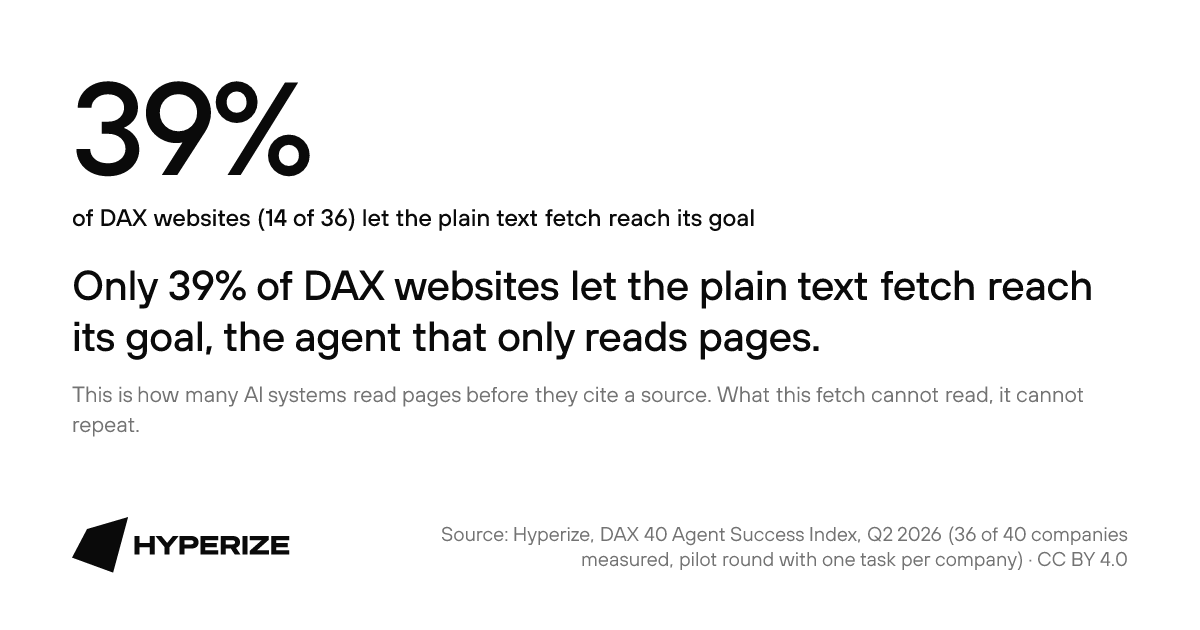
Only 39% of DAX websites let the plain text fetch reach its goal, the agent that only reads pages.
The plain text fetch loads only the text of a page, without clicks and without programs running in the background. Failing here means: an access block, an empty page shell or missing information, and all three occur.
This is how many AI systems read pages before they cite a source. What this fetch cannot read, it cannot repeat.
Whether an agent gets any further is usually decided on the first call to the website, before it sees an offer.
The ranking ends with adidas, Allianz, Bayer, SAP and BMW.
At the top are a telecoms group, a lab supplier, a logistics company and a chipmaker: Deutsche Telekom with 7.0 of 10, then Qiagen, DHL and Infineon S1. The last seven places go to Zalando (3.5), adidas (3.4), Allianz (3.2), Bayer (3.1), SAP (3.1), BMW (3.0), Brenntag (2.5). Six of them are names everyone knows.
The reasons are different every time. SAP rejects simple agents, and in the answers examined the AI points to implementation partners such as Accenture, Deloitte or Capgemini S13. At BMW a simple program cannot read a price in the configurator S14. At Bayer the agent finds Aspirin Forte, but no product page and no buy button S15.
Six brands score 5.0 or more. Thirteen stay below 4.0. The median is 4.1: the typical DAX company reaches less than half of the possible points. By sector, Logistics (6.5, one brand), Tech & Telecom (5.0), Industrials (4.9) and Pharma (4.9) lead, Automotive (3.7) and Chemicals (3.7) trail S1.
The typical DAX company reaches 4.1 of 10 points.
No agent bought anything, not even at the very top, because no test went as far as the purchase. Measurement ends at the cart, the quote or the order-ready price. Beyond that, where the agents got furthest, a customer account, a login or an identity check begins, at DHL a login before payment, which no agent tested S9 S10 S16 S17 S18. A cart reached is not a purchase yet. The last step still belongs to the human.
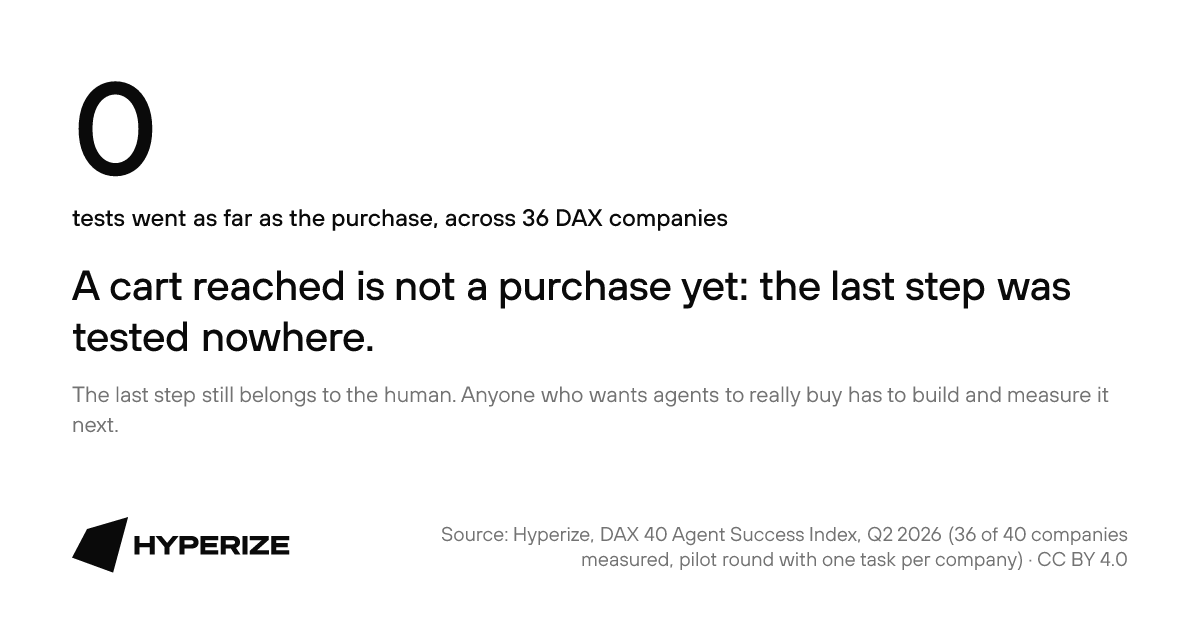
A cart reached is not a purchase yet: the last step was tested nowhere.
Purchases were not part of the tasks. Where agents got furthest, the next step sat behind an account, a login or an identity check; whether an agent can pass it was not examined.
The last step still belongs to the human. Anyone who wants agents to really buy has to build and measure it next.
Visible to AI and usable for agents barely relate.
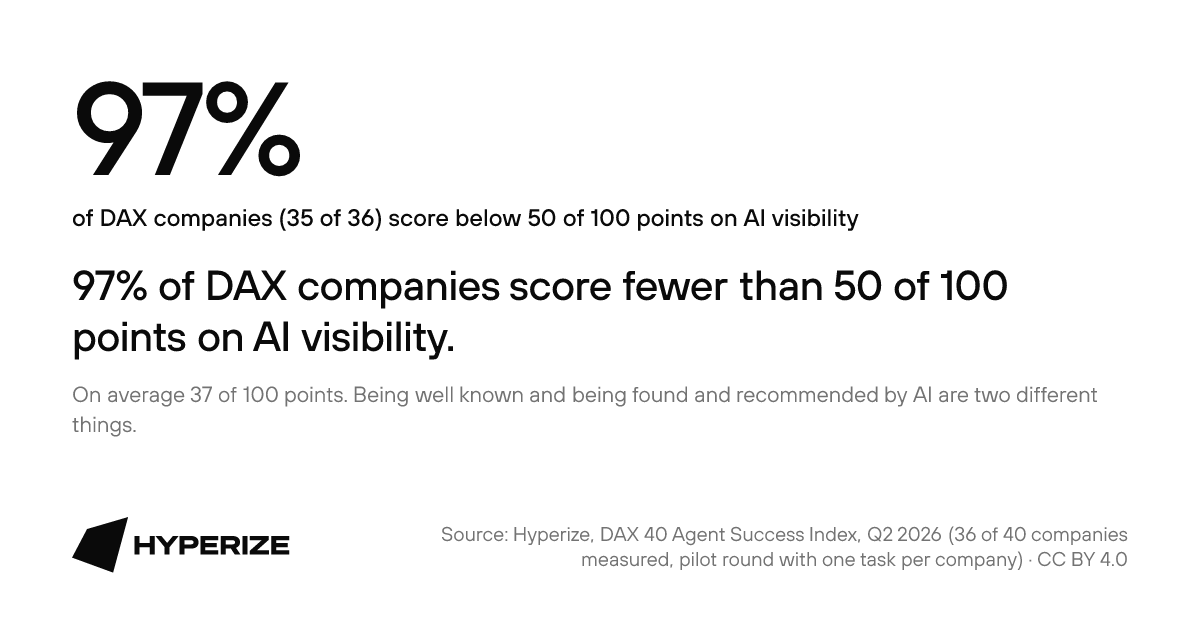
97% of DAX companies score fewer than 50 of 100 points on AI visibility.
AI visibility: a score from 0 to 100 for whether AI assistants find and recommend the brand when nobody names it; it bundles several signals and is not a simple mention rate. Each column is one company, without names.
On average 37 of 100 points. Being well known and being found and recommended by AI are two different things.
Being well visible to AI does not give a company a better website for agents. Qiagen has the website every agent type can use, usability 80, but scores 11.5 of 100 points on visibility to AI. Its reference page names the brand about once in ten cases on broad questions S5. Rheinmetall, Airbus and Volkswagen score between 44 and 50 points on visibility, and then the agent gets no further on the website: usability 30, 30 and 34 S1.
Across all 36, there is practically no linear relationship between the two values: the correlation coefficient is −0.02 (Pearson, 36 pairs of values) S1. 10 companies sit above both median lines, none by much; DHL, with visibility 46 and usability 68, gets furthest towards the top right S9. Anyone who only measures how visible their brand is to AI knows little, in these data, about how far an agent gets on their website. Both have to be right, otherwise the purchase stalls.
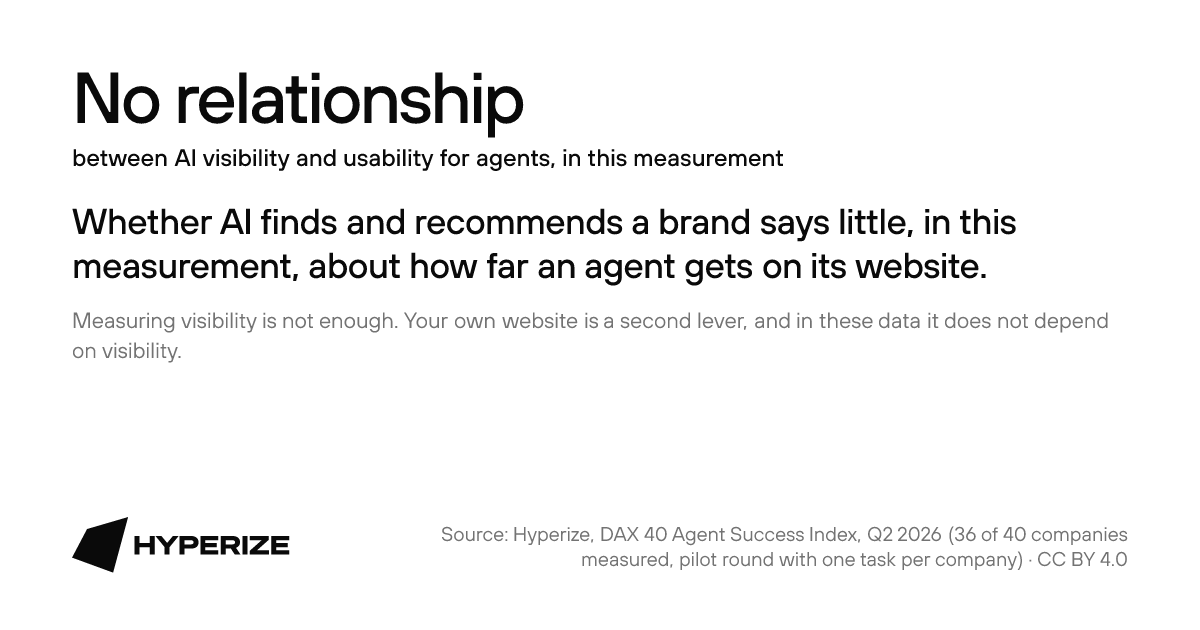
Whether AI finds and recommends a brand says little, in this measurement, about how far an agent gets on its website.
Each dot is one company: AI visibility to the right, usability upwards. Statistically r = −0.02 in this sample, so practically no linear relationship; no proof of independence.
Measuring visibility is not enough. Your own website is a second lever, and in these data it does not depend on visibility.
At 14 companies, according to AI answers, the purchase goes through third parties.
At 14 of the 36 companies, third parties regularly come before the brand in the AI answers to the task. That means a comparison portal, a retailer, a broker or an IT service provider S1. The index classifies this as structural, because in these industries the purchase usually happens there. What is measured are mentions in AI answers, not purchases. Henkel and Beiersdorf explain their product, dm, Rossmann and Amazon sell it. SAP describes the software, Accenture and Deloitte implement it. Munich Re and Hannover Rück are named, the contract is placed by Aon and Guy Carpenter, two large insurance brokers. A retailer, a broker and a competitor are not the same thing; each brand's reference page names exactly who comes before it.
At two companies the third party is avoidable: Deutsche Telekom and Allianz. There the agent reaches the brand directly as soon as the question names the brand, or the brand itself gives the best answer to the general question S4 S6. At 13 companies nobody stands in between in the evaluated answers; there, the company's own website alone decides. At seven companies this evaluation is still open.
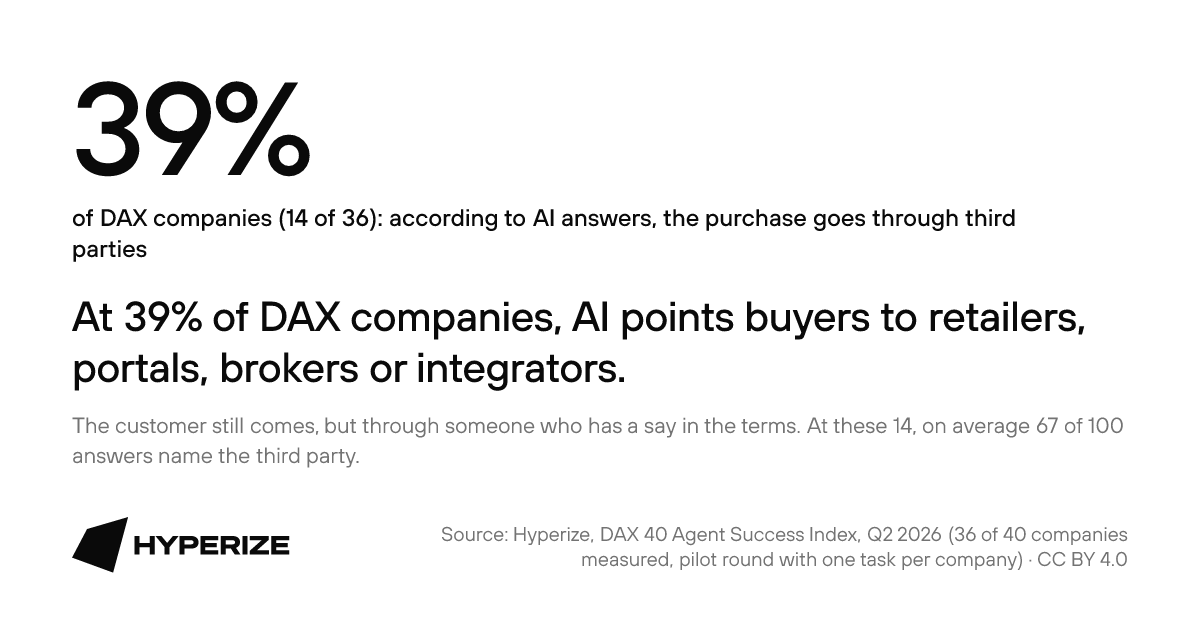
At 39% of DAX companies, AI points buyers to retailers, portals, brokers or integrators.
Counted are mentions in AI answers, not purchases. Structural means: in this industry the purchase usually goes through third parties. At 7 companies this evaluation is still open.
The customer still comes, but through someone who has a say in the terms. At these 14, on average 67 of 100 answers name the third party.
Measured on the side: 26 of 36 career sites let the agent get as far as the start of the application.
The index also measures a second lane, separate and never combined with the first. Can an applicant's agent find an open IT job on the brand's career site and get as far as the start of the application? Start means: the application can begin, at some brands behind a login. Task frozen on 2 July 2026, one job per brand, no application was submitted S12.
36 of the 40 members are measured S12:
- 26 times the agent reached the start of the application.
- 9 times it found the job and compared the requirements, but did not get as far as the start.
- 1 time the agent was turned away.
- 4 times no complete measurement came about.
There is no overall figure for this lane yet. Visibility to AI is missing, and without both values there is no score.
Three questions for your own website.
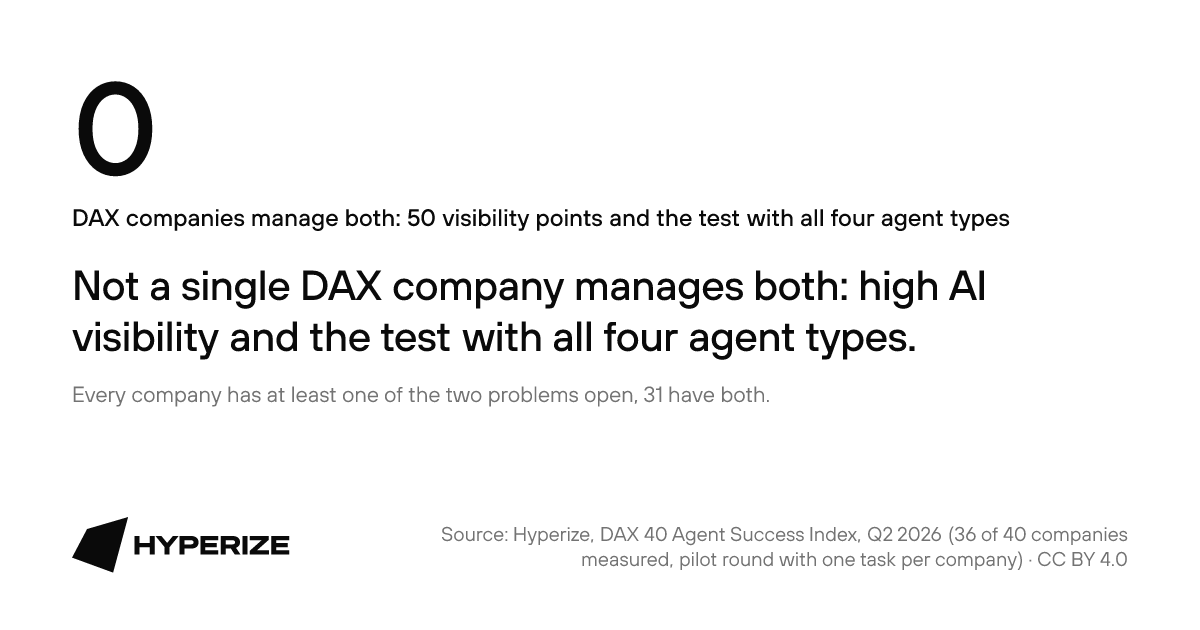
Not a single DAX company manages both: high AI visibility and the test with all four agent types.
High visibility: at least 50 of 100 points. Test passed: all four agent types reach their goal. Both thresholds are choices made by this article.
Every company has at least one of the two problems open, 31 have both.
This is only the beginning: which tasks agents will take on in future is open, and their number is growing. A company that turns every agent away today can look completely different in the next measurement round. Three questions decide that, and all three are in these numbers.
- Does AI find and recommend your brand when nobody names it?
- Does every agent type reach its goal on your website, including the simplest one, which only reads?
- Who does AI send buyers to, you or a third party?
The index weights usability (0.70) higher than visibility to AI (0.20) S2; which bottleneck comes first for a company is shown by its result on each value. We measure again in measurement round Q3 2026, with Hochtief and the next round of sectors. The numbers stay public.
Hyperize does not only measure this, it builds the pages through which AI agents can understand an offer and take the next step. The free Agent Success Snapshot shows, for one brand, where agents get further today and where they give up.
All 36 numbers to cite.
The eight insights are above, each in its place, each with a sentence and an image. What follows here are the licence, the data and the full table.
Hyperize (2026). DAX 40 Agent Success Index, Wave Q2 2026 Pilot. https://www.hyperize.ai/en/dax40-index
Data licence CC BY 4.0: cite the numbers, name the source, link to the index. Numbers as of 2026-09-14. This page is the dated record of measurement round Q2 2026; the index itself keeps measuring.
- DAX 40 Agent Success Index, HTML: https://www.hyperize.ai/en/dax40-index
- DAX 40 Agent Success Index, JSON twin (the same data in a format for programs): https://www.hyperize.ai/en/dax40-index.json
- This page, HTML: https://www.hyperize.ai/en/insights/articles/can-an-ai-agent-buy-from-a-dax-company
- This page, JSON twin: https://www.hyperize.ai/en/insights/articles/can-an-ai-agent-buy-from-a-dax-company.json
- All 36 values as CSV: https://www.hyperize.ai/data/dax40-agent-success-q2-2026.csv
- Agent Success Score, methodology: https://www.hyperize.ai/en/methodology/agent-success-score
- Task selection (Task Selection Doctrine): https://www.hyperize.ai/en/methodology/task-selection
For humans, the ranking is above. For machines and for citing, the same table with both values follows.
| Rank | Brand | Ticker | Sector | AI Visibility | AI Usability | Evidence | Score |
|---|---|---|---|---|---|---|---|
| 1 | Deutsche Telekom | DTE | Tech & Telecom | 33.8 | 80 | 70 | 7.0 |
| 2 | Qiagen | QIA | Pharma & Healthcare | 11.5 | 80 | 98 | 6.8 |
| 3 | DHL Group | DHL | Logistics | 46.0 | 68 | 85 | 6.5 |
| 4 | Infineon | IFX | Industrials | 39.1 | 68 | 70 | 6.2 |
| 5 | Siemens | SIE | Industrials | 44.0 | 57 | 70 | 5.6 |
| 6 | Merck | MRK | Pharma & Healthcare | 38.3 | 54 | 68 | 5.2 |
| 7 | Deutsche Bank | DBK | Insurance & Finance | 40.5 | 48 | 70 | 4.9 |
| 8 | MTU Aero Engines | MTX | Aerospace & Defense | 52.5 | 45 | 65 | 4.8 |
| 9 | Commerzbank | CBK | Insurance & Finance | 38.0 | 48 | 70 | 4.8 |
| 10 | Fresenius Medical Care | FME | Pharma & Healthcare | 45.0 | 44 | 70 | 4.7 |
| 11 | Siemens Energy | ENR | Industrials | 41.9 | 45 | 65 | 4.6 |
| 12 | Fresenius | FRE | Pharma & Healthcare | 40.6 | 44 | 70 | 4.6 |
| 13 | Symrise | SY1 | Chemicals & Materials | 36.3 | 44 | 65 | 4.5 |
| 14 | Vonovia | VNA | Real Estate | 42.8 | 41 | 70 | 4.4 |
| 15 | Hannover Rück | HNR1 | Insurance & Finance | 28.2 | 45 | 65 | 4.4 |
| 16 | Munich Re | MUV2 | Insurance & Finance | 44.2 | 38 | 65 | 4.2 |
| 17 | GEA Group | G1A | Industrials | 40.3 | 38 | 65 | 4.1 |
| 18 | Henkel | HEN3 | Consumer & Retail | 35.3 | 39 | 65 | 4.1 |
| 19 | BASF | BAS | Chemicals & Materials | 37.7 | 39 | 60 | 4.1 |
| 20 | Volkswagen | VOW3 | Automotive | 49.7 | 34 | 70 | 4.1 |
| 21 | Beiersdorf | BEI | Consumer & Retail | 34.4 | 39 | 65 | 4.1 |
| 22 | Siemens Healthineers | SHL | Industrials | 33.3 | 38 | 65 | 4.0 |
| 23 | Mercedes-Benz | MBG | Automotive | 43.6 | 34 | 70 | 4.0 |
| 24 | Rheinmetall | RHM | Aerospace & Defense | 49.4 | 30 | 65 | 3.7 |
| 25 | Daimler Truck | DTG | Automotive | 21.4 | 38 | 65 | 3.7 |
| 26 | E.ON | EOAN | Utilities | 26.3 | 35 | 70 | 3.7 |
| 27 | Airbus | AIR | Aerospace & Defense | 43.9 | 30 | 65 | 3.6 |
| 28 | Continental | CON | Automotive | 26.4 | 34 | 65 | 3.6 |
| 29 | Heidelberg Materials | HEI | Chemicals & Materials | 40.2 | 30 | 65 | 3.6 |
| 30 | Zalando | ZAL | Consumer & Retail | 43.3 | 28 | 70 | 3.5 |
| 31 | adidas | ADS | Consumer & Retail | 35.0 | 28 | 70 | 3.4 |
| 32 | Allianz | ALV | Insurance & Finance | 19.8 | 30 | 70 | 3.2 |
| 33 | Bayer | BAYN | Pharma & Healthcare | 22.1 | 30 | 53 | 3.1 |
| 34 | SAP | SAP | Tech & Telecom | 29.4 | 26 | 65 | 3.1 |
| 35 | BMW | BMW | Automotive | 37.6 | 23 | 65 | 3.0 |
| 36 | Brenntag | BNR | Chemicals & Materials | 24.2 | 19 | 70 | 2.5 |
Questions about the data: hello@hyperize.ai.